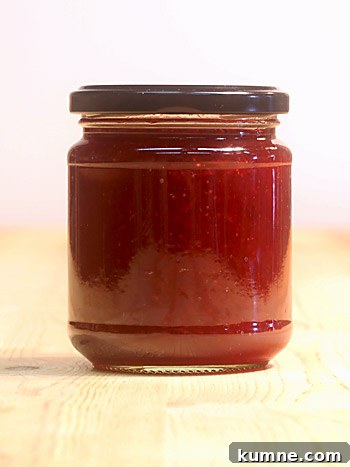
Mrs. Beeton’s 1861 Strawberry Jam Recipe
Strawberry jam is a timeless favourite for many—sweet, fragrant berries transformed into a spread that’s perfect on buttered bread or warm toast. Picking strawberries is a delightful summer activity, and making jam from your haul rewards the effort with jars of fresh, homemade flavour. If you are new to preserving, consider reading an overview of jam and preserve making to learn the basic principles before starting.
Strawberries often contain more moisture than some other fruits, so they may require a slightly longer boil to evaporate excess liquid and reach a good setting point. While boiling, watch for a visible thickening during a vigorous boil before testing or potting the jam.
Some cooks add commercial pectin or use jam sugar that already contains pectin, but it isn’t always necessary. A thorough boil in a proper preserving pan usually yields a good result. This recipe also uses redcurrant juice, which contributes natural pectin to help the jam set.
1861 Mrs. Beeton’s STRAWBERRY JAM.
INGREDIENTS – To every lb. of fruit allow 1/2 pint of red-currant juice, 1–1/4 lb. of loaf sugar.
Mode.—Clean and hull the strawberries, put them into a jar; place this jar in a saucepan of boiling water, and simmer until the juice is well drawn from the fruit; strain the currants, measure the juice, put it into a preserving-pan, and add the sugar. Select well-ripened but sound strawberries; pick them from the stalks, and when the sugar is dissolved in the currant juice, put in the fruit. Simmer the whole over a moderate fire, from 1/2 to 3/4 hour, carefully removing the scum as it rises. Stir the jam only enough to prevent it from burning at the bottom of the pan, as the fruit should be preserved as whole as possible. Put the jam into jars, and when cold, cover down.
How to test whether the jam will set
Recipes often instruct to “boil until the jam sets” — experienced makers know how to check this. Spoon a little of the hot jam onto a cold plate, let it cool for a minute, then gently push the surface with a finger. If it has reached the setting point, the top will wrinkle and form a slight skin. If you prefer a more precise method, use a thermometer: many jams reach setting point when boiled at around 104–105°C (219–221°F) for several minutes.
Strawberry Jam Recipe
Note: this recipe produces a jam that remains naturally soft and slightly oozing rather than a very firm jelly. For a firmer set, add commercial pectin, use a jam sugar with added pectin, or extend the boiling time.
Recipe Ingredients:
- 2 kg strawberries
- 2 kg sugar
- 500 g redcurrants
- 150 ml water
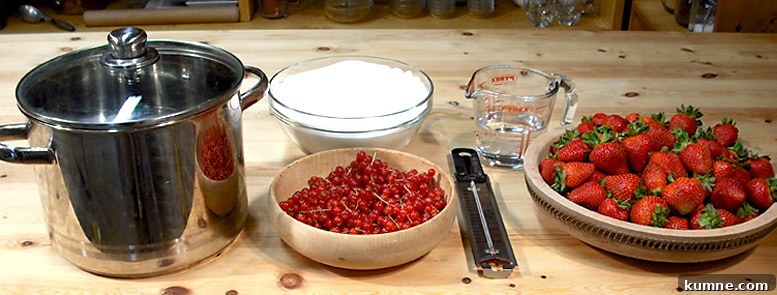
Strawberry Jam Ingredients | 1861 Recipe
Recipe Method:
Prepare the strawberries by cleaning and hulling them: trim the tops and remove the cores, cutting larger berries in half. In a medium saucepan combine the water and redcurrants and simmer gently for about 15 minutes. After around 10 minutes, press the redcurrants with a masher to help release their juice.
Strain the cooked redcurrants through a fine sieve into a heavy-bottomed preserving pan or large saucepan, using the back of a spoon to extract as much juice as possible. You should obtain roughly 500 ml of juice. Discard the solids left in the sieve.
Return the strained redcurrant juice to the preserving pan over medium heat and add the sugar, stirring until the sugar is fully dissolved. Add the prepared strawberries, reduce the heat to a gentle simmer, and cook for about 45 minutes until the fruit softens. Stir occasionally and gently to avoid breaking up the berries. Skim off any foam or impurities that rise to the surface.
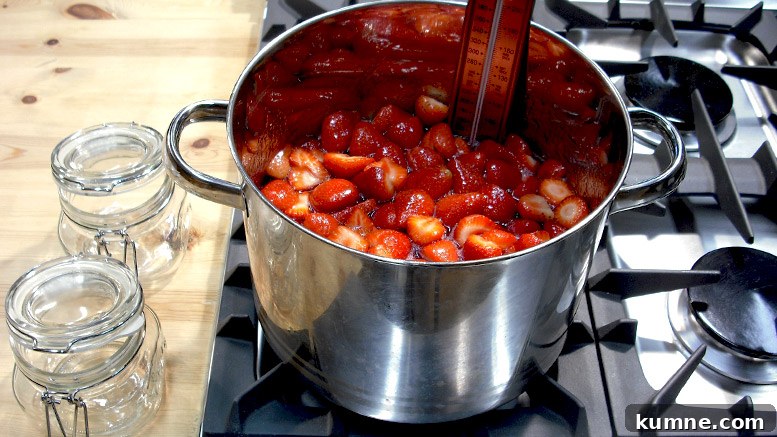
Ready To Boil The Strawberry Jam
After the gentle simmer, increase the heat to bring the mixture to a rapid boil for about 10 minutes to concentrate the liquid and encourage thickening. If using a jam thermometer, a sustained temperature around 104°C indicates the pectin and acid are reacting with the sugar and the jam should set as it cools. Use the cold plate test to confirm the set.
When the jam reaches setting point, ladle it into warm, sterilised jars. Allow the jars to cool before sealing. Label each jar with the contents and the date made. Properly sealed and stored in a cool, dark cupboard, the jam will keep for up to six months.