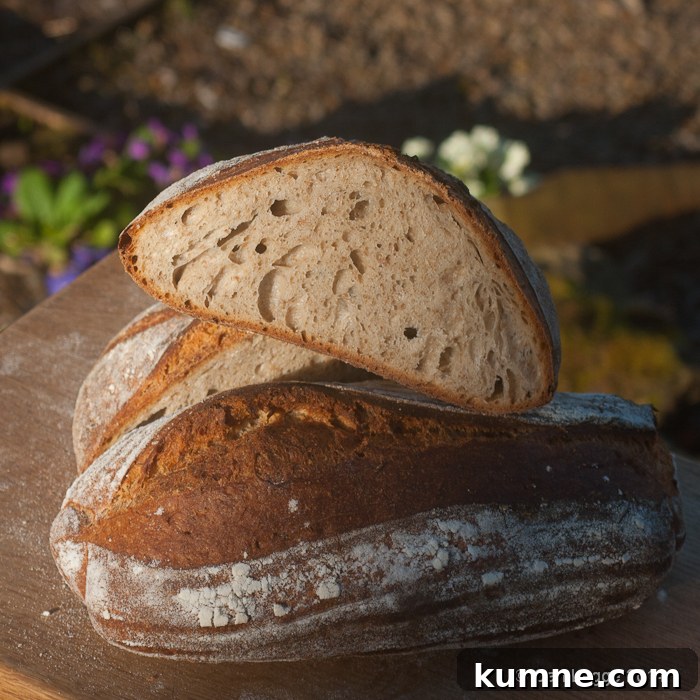
This successful experiment could change the way I bake: it lets me make a sourdough-style loaf within 24 hours without maintaining an active flour-and-water starter.
The resulting bread is moist and chewy, with a rich malty wholemeal flavour and a crisp, deeply coloured crust. It isn’t sharply acidic — if you prefer a tangier loaf you can extend fermentation with an overnight fridge retard.
If you want to try this method, read on.
Kombucha Sourdough Bread Recipe
In this method I use kombucha to activate a poolish (sponge or batter) and then use that poolish to start the main dough fermentation.
Kombucha is a symbiotic culture of bacteria and yeast (SCOBY). Yeasts ferment sugars to alcohol, and bacteria such as acetobacter convert that alcohol into acetic and gluconic acids. I keep a steady supply of kombucha and use one that is still pleasant to drink and not overly acidic so it retains some fermentable sugars — this helps the leaven start quickly and keeps the poolish from tasting too sour.
For the poolish I chose coarse wholemeal and rye flours: wholemeal for flavour and texture, and rye to give the culture easily fermentable components and a quicker start. You can substitute flours to suit your taste; the final colour, texture and flavour will vary accordingly. I also add a little honey to provide readily available sugars for the culture.
My poolish uses a looser hydration than my usual leaven (roughly twice as much liquid to flour by weight) to encourage faster activity.
Ingredients
For the poolish
150g coarse wholemeal flour
50g wholemeal rye flour
30g runny honey (warm gently if solid)
300g active kombucha tea (not too sour)
For the dough
860g strong white bread flour
440g warm water
18g fine sea salt
Total dough yields roughly 1.8kg, enough for two large loaves.
Method
The night before baking, combine the poolish ingredients and cover with a tea towel, muslin or a plastic bag. Leave in a warm spot — around 20–24°C is ideal. I use a seed propagator set to about 22°C.
By morning the poolish should be bubbly and slightly separated, smelling pleasantly sweet and yeasty. Taste it; it should be mild and porridge-like rather than sharply sour.
Mix the poolish with the dough ingredients in a large bowl until combined. Cover and leave in a warm place. Perform four sets of stretch-and-folds at roughly hourly intervals to develop gluten and strength.
After the folding stage, divide the dough into two equal pieces and shape them. Place the shaped loaves into bannetons or onto well-floured parchment or baking surfaces.
Allow the loaves to prove in a warm place for about 2–4 hours, depending on temperature. You want the dough to show signs of gas development and still have some spring; press lightly with a finger — the dough should slowly resist and recover. Aim for about 25–50% volume increase rather than a dramatic doubling.
About 45–60 minutes before baking, preheat your oven to its highest setting. It’s better to be ready early than to start with an oven that isn’t hot enough. For steam, place a tray of boiling water in the oven or use your preferred steam method at the beginning of the bake.
Slash the loaves as you like, then bake at 240°C with steam for 15 minutes. Remove the steam and lower the temperature to 190°C, baking for a further 30–35 minutes or until the crust reaches the colour and crispness you prefer.
The result is an attractive, flavorful bread with the texture and chew expected from a good sourdough-style loaf. Because the poolish is activated with kombucha rather than a maintained flour starter, this method gives extra flexibility: you can bake within a day without an active sourdough culture on hand.
If you don’t brew kombucha regularly, consider other fermented starters — kefir, cider or wine barm, potato-based mixes, or specialty flours can all be used as alternative levains depending on the flavour profile you want.
What’s your favourite leaven?