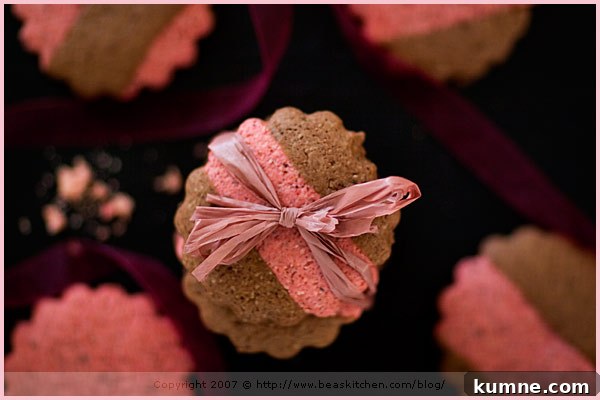
The first thing I asked P. when he came home was whether he had liked the cookies I’d managed to slip into his bag before he left. He often asks me to bake cookies—I don’t do it nearly as often as he requests.
“How did you do that?” he asked.
“Do what?” I replied, puzzled.
“The pattern on the cookies.”
Aha!
I realized I knew something he didn’t, and for a moment that made me feel a little triumphant. I’m usually terrible at assembling things—furniture that requires instructions is my nemesis. Even though such items come with manuals, I avoid reading them. It’s ironic since I used to translate user guides; they bored me then and they bore me now. If left with an unassembled piece of furniture, I procrastinate for days before finally asking P. for help. He has the patience for those tasks and actually enjoys assembling and troubleshooting things.
With food, though, it’s a different story. I love challenging myself to try new recipes and to understand the techniques behind them. Maybe that industrial drawing class I took in high school helped in some unexpected way—even though my teacher used to tell me the pieces I drew couldn’t be assembled. “C’est joli, mais c’est un montage impossible, mademoiselle Peltre,” he would say. Still, with baking I feel more confident: food allows for experimentation and creative assembly.
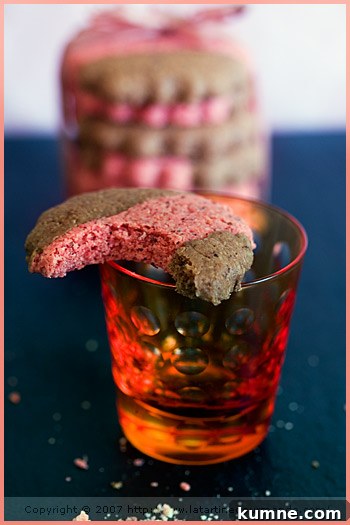
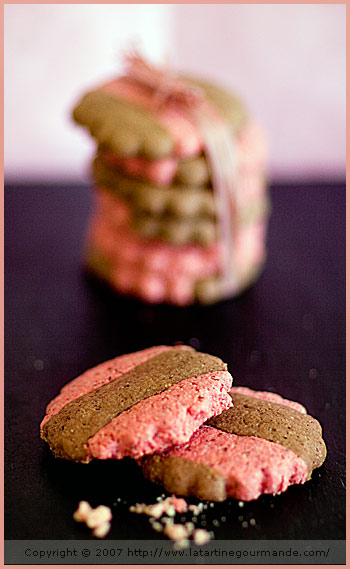
I found the inspiration for these cookies in a recent issue of Cuisine et Vins de France. The magazine’s version used Biscuits Roses de Reims to give a pink color and almond flour for texture. I liked the idea but wanted the cookies to be more colorful and to have a pattern. I decided to pair two colors I find beautiful together: chocolate and pink. Chocolate is one of my little indulgences, so adding it was an easy choice. Creating the pattern wasn’t complicated, yet watching P.’s amazed reaction was delightful—perhaps he simply doesn’t spend enough time in the kitchen.
Everyone has their strengths. For me, baking was the place to prove that I can assemble things after all. If only my old industrial drawing teacher could see me now—this time, montage possible.
You need:
- For the pink dough:
- 1/2 cup Biscuits Roses de Reims powder (about 6 biscuits crushed finely)
- 4 Tbsp butter, melted
- A few drops of red food coloring (optional)
- 1/2 tsp baking powder
- 1 large egg
- 1/2 cup all-purpose flour
- 2/3 cup hazelnut flour
- 1.5 Tbsp confectioners’ sugar
- 2/3 cup + 1 Tbsp all-purpose flour
- 2 Tbsp good-quality unsweetened cocoa powder
- 1/2 cup confectioners’ sugar
- 2/3 cup hazelnut flour
- 1/2 tsp baking powder
- 1 large egg
- 4 Tbsp butter, melted
For the chocolate dough:
Steps:
Note: Prepare the two doughs separately, following the same method for each.
- Melt the butter. Add coloring for the pink dough or cocoa for the chocolate dough and mix until smooth.
- Sift each dry ingredient separately: flour, baking powder, hazelnut flour and confectioners’ sugar.
- Place the dry ingredients in a mixing bowl—include the Biscuits Roses powder for the pink dough—and add the melted butter gradually. Mix until combined.
- Add the egg and mix until the dough is uniform. Shape into a ball, wrap in plastic, and chill for 2 hours.
- Repeat the process for the second dough.
- After resting, roll each dough to about 1/3 inch thickness.
- Preheat the oven to 350°F (180°C).
- Cut long strips from each dough and place them side by side, alternating chocolate and pink. Press the seams to ensure the strips stick together—use a rolling pin if needed.
- Cut cookies with your preferred cutter and transfer to a baking sheet.
- Bake for about 10 minutes. Cool on a wire rack. Store in an airtight tin for several days, if you can resist eating them immediately.
Ingrédients :
- Pour la pâte rose :
- 50 g de poudre de Biscuits roses de Reims (6 biscuits réduits en poudre fine)
- 60 g de beurre fondu
- Quelques gouttes de colorant rouge (facultatif)
- 1/2 càc de levure chimique
- 1 gros œuf
- 70 g de farine
- 70 g de poudre de noisettes
- 20 g de sucre glace
- 120 g de farine
- 2 càs de cacao non sucré, de qualité
- 60 g de sucre glace
- 70 g de poudre de noisettes
- 1/2 càc de levure chimique
- 1 gros œuf
- 60 g de beurre fondu
Pour la pâte chocolat :
Étapes :
Remarque : Préparez les deux pâtes séparément en suivant le même principe.
- Faites fondre le beurre. Ajoutez le colorant pour la pâte rose ou le cacao pour la pâte chocolat et mélangez jusqu’à obtenir une texture lisse.
- Tamisez la farine, la levure, la poudre de noisettes et le sucre glace séparément.
- Mélangez les ingrédients secs—incluez la poudre de Biscuits Roses pour la pâte rose—puis incorporez le beurre fondu progressivement.
- Ajoutez l’œuf et travaillez la pâte jusqu’à obtenir une boule homogène. Enveloppez-la et réfrigérez 2 heures.
- Procédez de la même façon pour la deuxième pâte.
- Étalez les pâtes sur 1 cm d’épaisseur.
- Préchauffez le four à 180°C.
- Découpez des bandes et placez-les côte à côte en alternant chocolat et rose. Appuyez pour sceller les joints, à l’aide d’un rouleau si nécessaire.
- Découpez les sablés avec un emporte-pièce, disposez-les sur une plaque et enfournez 10 minutes. Laissez refroidir sur une grille. Conservez dans une boîte métallique quelques jours.